You've probably seen it floating around on productivity blogs or study TikTok: the 8-8-8 rule. The idea is seductively simple. Divide your day into three equal, neat blocks: 8 hours for work, 8 hours for leisure, and 8 hours for sleep. For a college student drowning in deadlines, social FOMO, and perpetual exhaustion, it sounds like a utopian blueprint.
But here's the raw truth from someone who's coached students through this for years: treating the 8-8-8 rule as a rigid, daily mandate is a recipe for feeling like a failure. Your Tuesday with back-to-back labs and a club meeting looks nothing like your lazy Sunday. The magic isn't in hitting the numbers perfectly every day. It's in using the framework to become the intentional architect of your time, rather than its frantic victim.
This guide isn't about forcing you into a rigid schedule. It's about adapting the core philosophy of the 8-8-8 rule to the chaotic, beautiful reality of university life. We'll break down what each block really means, show you how to track your time honestly, and provide flexible strategies for students with jobs, heavy majors, or irregular schedules.
What You'll Find in This Guide
- Deconstructing the 8-8-8 Rule: What Each Block Really Means
- Why the "Perfect" 8-8-8 Split Often Fails for Students
- Practical Adaptation: Making the Rule Work for Your Real Schedule
- Step-by-Step: Tracking Your Time Without Losing Your Mind
- Beyond the Numbers: The Mindset Shift for Long-Term Success
- Your Questions Answered (The Real Stuff)
Deconstructing the 8-8-8 Rule: What Each Block Really Means
Let's get specific. Vague categories lead to vague results. When we say "8 hours for work" in a college context, what are we actually counting?
The "Work" Block (It's Not Just Studying)
This is your primary productive output. For students, it includes:
- Focused Academic Work: Attending lectures, seminars, and labs. Active studying in the library (Pomodoro sessions, problem sets, writing papers). Group project meetings where actual work gets done.
- High-Quality Practice: Rehearsals for theater or music majors, studio time for artists, coding practice for CS students.
What it explicitly does not include: scrolling through class readings while watching Netflix, or "studying" in your dorm with constant phone interruptions. That's not work; that's a gray zone of stress.
A Common Pitfall: Students often lump "commuting," "eating alone," and "quick errands" into work. Don't. These are maintenance activities. Confusing them with focused work inflates your work hours and makes the 8-8-8 balance seem impossible.
The "Leisure" Block (The Most Misunderstood Part)
Leisure is active recovery. It's what genuinely refills your tank.
- Social Connection: Meals with friends, parties, club activities, video calls with family.
- Physical Activity: Going to the gym, a run, intramural sports, a yoga class.
- Hobbies & Passion Projects: Playing an instrument for fun, reading a novel, gaming, creative writing.
- True Relaxation: Mindful walks, meditation, watching a movie without multitasking.
The trap? Mistaking passive consumption for leisure. Four hours of aimless TikTok or Instagram scrolling often leaves you more drained, not less. That time usually bleeds from your sleep block, creating a vicious cycle.
The "Sleep" Block (The Non-Negotiable Foundation)
This is 8 hours of actual sleep in bed, not 8 hours in bed with 1.5 hours of scrolling. The research from organizations like the National Sleep Foundation is unequivocal: for young adults, 7-9 hours is essential for memory consolidation, emotional regulation, and immune function. Sacrificing sleep to cram is like trying to drive a car on fumes—you might move, but you're damaging the engine.
Why the "Perfect" 8-8-8 Split Often Fails for Students
The theory clashes with reality in a few predictable ways.
Class schedules are lumpy. You might have 6 hours of classes and labs on Monday, but only 2 on Friday. A part-time job might demand 15-20 hours a week, completely disrupting the neat 8-hour work/leisure divide. Exam weeks demand a temporary surge in focused work, while spring break is heavy on leisure.
The biggest failure point is the expectation of daily perfection. Seeing a 10-5-9 split on a busy day and thinking "I failed the rule" is counterproductive. The rule is a compass, not a GPS turn-by-turn command.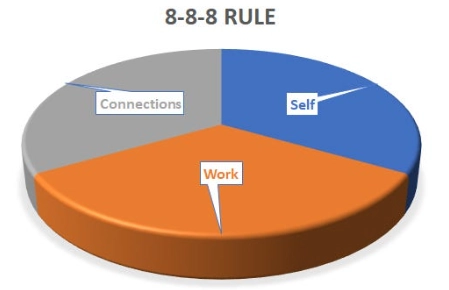
Practical Adaptation: Making the Rule Work for Your Real Schedule
Forget daily perfection. Think in terms of weekly balance and intentional allocation.
Let's look at two common student scenarios through an adapted 8-8-8 lens:
| Student Profile | The Challenge | Adapted 8-8-8 Strategy | Sample Weekly Focus |
|---|---|---|---|
| Alex: Engineering Major | Heavy problem sets, long labs. Feels like he should always be studying. | Protect Sleep, Buffer Leisure. Accept that "Work" will sometimes be 10+ hours. Schedule 2-3 protected leisure slots per week (e.g., Thursday night basketball, Sunday hike) and treat them as unbreakable appointments. Use the rule to ensure leisure isn't erased. | Sleep: 56 hrs (avg 8/night). Work: 70 hrs (academic). Leisure: 42 hrs. The leisure is protected quality time. |
| Sam: Works 20 hrs/week at a cafe | Paid work consumes time from both "Work" and "Leisure" blocks. | Combine & Allocate. Paid work + Academic work = Total "Work" Output. After sleep (8) and paid work (4), Sam has 12 waking hours. They must consciously split this between academics and personal time. Without a plan, the job eats everything. | Sleep: 56 hrs. Total Work (Job + Study): 65 hrs. Leisure/Maintenance: 47 hrs. The key is planning study sessions in advance. |
See the shift? The numbers become a tool for awareness, not a judgment.
Step-by-Step: Tracking Your Time Without Losing Your Mind
You can't manage what you don't measure. But tracking doesn't need to be a prison.
Pick one typical academic week (not finals week). Don't try to change your behavior yet; just observe.
- Choose a simple tool: A notes app, a spreadsheet, or a simple app like Toggl Track.
- Log in 30-minute blocks: From waking to sleeping. Be brutally honest.
- Categorize each block: Use: Focused Work, Class/Lab, Paid Job, Maintenance (meals, chores, commute), Quality Leisure, Passive Consumption, Sleep.
- Analyze at week's end: Where did your time actually go? The gap between your perception and reality is where you'll find pockets of time. Most students find 10-15 hours lost in unoptimized "Maintenance" and mindless "Passive Consumption."
That reclaimed time is your leverage to move closer to a balanced 8-8-8 feel, even if the exact numbers differ.
Beyond the Numbers: The Mindset Shift for Long-Term Success
The ultimate goal of playing with the 8-8-8 rule isn't a pretty spreadsheet. It's to cultivate three key mindsets:
1. Intentionality Over Reactivity. Instead of the day happening to you, you decide, in advance, how to allocate your finite hours. You schedule leisure with the same seriousness as a study session.
2. Viewing Leisure as Productive. This is critical. Social connection and recovery aren't distractions from success; they are prerequisites for sustained academic performance. Research in fields like psychology underscores the link between social support, mental well-being, and resilience. That party or gym session is an investment in your capacity to work tomorrow.
3. Embracing Flexible Rhythms. Some weeks are 9-7-8. Some are 6-10-8. That's okay. The rule serves you, not the other way around. The constant is protecting your sleep and ensuring leisure doesn't permanently vanish.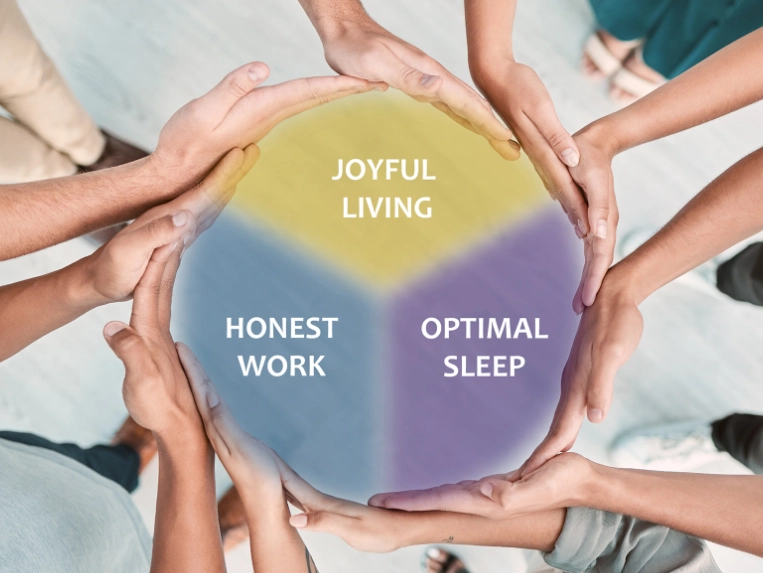
Your Questions Answered (The Real Stuff)
Is the 8-8-8 rule realistic for engineering or pre-med students with heavy course loads?
For students in demanding majors, a strict 8-8-8 split is often unrealistic and can lead to frustration. The core value isn't the rigid numbers, but the intentional balancing act. For you, the 'work' block likely needs to be larger. The key is to protect the 8-hour sleep foundation at all costs, then consciously allocate the remaining 16 hours between academic work and personal time. You might operate on a 10-6-8 model during midterms, then shift back. The rule's power is in making you the conscious allocator of your time, not a passive victim of your schedule.
How do I actually track my time to see if I'm close to the 8-8-8 balance?
Don't guess, track. For one typical week, use a simple spreadsheet or a time-tracking app like Toggl or even your phone's notes. Log everything in 30-minute blocks. Categorize each block as Sleep, Focused Work (lectures, library study), Maintenance (eating, commuting, chores), or Leisure. The shocking revelation for most students isn't the total study hours, but how much time vanishes into unplanned 'Maintenance' and low-quality scrolling that could be reclaimed for genuine leisure or extra sleep. This data is your starting point for intentional adjustment.
My part-time job takes 20 hours a week. How does the 8-8-8 rule work then?
This is where the framework needs a major tweak. Your job hours come out of the combined 'Work' and 'Leisure' buckets. Let's say you work 4 hours a day, 5 days a week. You now have 12 hours left in your waking day (24 - 8 sleep - 4 job). The goal is to consciously split those 12 hours between academic work and personal recovery. You might do 7 hours of study and 5 for leisure/everything else. The principle remains: be intentional. Without this awareness, work can consume all discretionary time, leading to academic neglect or complete burnout. Schedule your study sessions like fixed appointments to protect them.
What's the biggest mistake students make when trying to follow the 8-8-8 rule?
They treat 'Leisure' as wasted time or feel guilty about it. This is backwards. Quality leisure—socializing, exercise, hobbies, true relaxation—isn't a reward for work; it's the essential fuel that recharges your cognitive and emotional batteries. The mistake is filling the leisure block with passive consumption (endless YouTube, doomscrolling) which doesn't truly recharge you. If your 8 hours of 'leisure' leave you feeling just as drained, you didn't have leisure, you had avoidance. Schedule active leisure that genuinely restores you, and defend that time. A well-rested, socially connected student is a more efficient learner.
So, what is the 8-8-8 rule for college students? It's not a rigid prescription. It's a lens. A framework for awareness. A reminder that a fulfilling college life requires a conscious investment in all three pillars: your academics, your rest, and your humanity. Start by tracking a week. See where your time goes. Then, start making small, intentional shifts. Protect your sleep fiercely. Schedule your fun. Your GPA—and your sanity—will thank you.
Leave a Comment