You’re staring at a blank document, the deadline is looming, and that research paper feels like a mountain. A quick search suggests AI can write it for you. Tempting, right? But a nagging voice asks: is this okay? Will I get caught? Is it even ethical?
Let’s cut to the chase. Using AI to generate your entire paper and submit it as your own work is plagiarism. It’s not okay, and most universities have policies against it that can lead to serious consequences. However, using AI as a tool to assist, enhance, and streamline your research and writing process is not only okay, it’s becoming a smart academic skill. The real question isn’t a simple yes or no. It’s about drawing a clear, ethical line between using a powerful tool and committing academic fraud.
I’ve reviewed papers where the introduction was clearly AI-generated—vague, buzzword-heavy, and utterly disconnected from the paper’s actual findings. It was the first red flag. On the flip side, I’ve seen students use AI to overcome writer’s block for a methodology section or to brainstorm counter-arguments, resulting in stronger, more nuanced work. The difference is night and day.
What’s Inside This Guide
Where’s the Ethical Line? What You Can and Cannot Do
Think of AI not as a ghostwriter, but as a research assistant or a brutally honest peer reviewer. Its role is to support your intellectual labor, not replace it. The core of your paper—your original argument, your analysis of data, your unique synthesis of ideas—must come from you.
The Golden Rule of AI in Academia
You must maintain ultimate intellectual accountability. If you cannot confidently explain and defend every claim, source, and logical step in your paper, you’ve crossed the line from using a tool to outsourcing your thinking.
Here’s a quick breakdown to make it crystal clear:
| Generally OK (Tool Use) | Not OK (Academic Dishonesty) |
|---|---|
| Using AI to brainstorm research questions or keywords. | Prompting AI to “write a 3000-word paper on topic X” and submitting it. |
| Asking it to explain a complex concept from your readings. | Using AI to fabricate citations or data. |
| Getting feedback on your paragraph structure or clarity. | Paraphrasing AI-generated text without adding your own analysis. |
| Using it to check grammar, spelling, and tone. | Hiding your use of AI when your professor or journal requires disclosure. |
| Summarizing long articles or books to identify relevance. | Using AI to complete an assignment designed to assess your specific skills. |
Practical Uses: How AI Can Actually Help Your Paper
Let’s get concrete. Where does AI fit into the messy, real-world process of writing a paper?
1. The Pre-Writing and Research Phase
This is where AI shines without touching ethical gray areas. Stuck on a topic? Ask an AI to generate 10 potential research questions within a broad field. Overwhelmed by 50 PDFs? Use an AI research assistant (like Scite, Elicit, or Consensus) to quickly extract key claims, find supporting/contradicting papers, and summarize methodologies. It’s like having a super-fast, initial literature scan. The synthesis and decision on what’s truly important, though, is still your job.
2. The Writing and Drafting Phase
Writer’s block is real. Instead of staring, try this: write your messy, ugly first draft yourself. Then, feed a problematic paragraph to an AI and ask: “How can I make this argument clearer?” or “Rephrase this for a more academic tone.” Use the output as inspiration, not a copy-paste solution. I often ask ChatGPT to act as a skeptical reviewer: “What are the three weakest points in this hypothesis?” The answers can be brutally helpful for strengthening your work.
3. The Editing and Polishing Phase
AI is a fantastic copy editor. Tools like Grammarly (which now has AI features) or even the built-in editor in Word can catch passive voice, long sentences, and inconsistent terminology. This frees you up to focus on the substance. A key tip: never let AI edit for “flow” or “creativity” in your core analytical sections. It tends to homogenize voice and strip out the unique academic “fingerprint” that comes from your deep engagement with the material.
A Step-by-Step Framework for Using AI Ethically
Here’s a workflow I recommend to my students. It keeps you in the driver’s seat.
Step 1: Foundation First. Do your own reading, note-taking, and idea formation first. Sketch an outline with your own brain. This is non-negotiable.
Step 2: Targeted AI Assistance. Identify specific bottlenecks. Is it the literature review organization? The wording of your hypothesis? Use AI with a precise, narrow prompt related to that bottleneck.
Step 3: Synthesize and Rewrite. Never copy-paste AI output. Read it, understand the suggestion, then close the AI window and rewrite the section in your own words, integrating the useful idea. This step is what transforms AI help into your own learning.
Step 4: Disclose and Cite. If your professor’s policy or your target journal’s author guidelines (like those from Nature or Elsevier) ask for AI use disclosure, include it. Be transparent. Some styles now suggest acknowledging AI in your Acknowledgements or Methods section.
Step 5: Final Human Review. Read your entire paper aloud. Does it sound like you? Does every part connect logically to your research? This final sense-check is your quality control.
Journal and University Policies: The Rules of the Game
“Okay” is also defined by the rules you’re playing under. These are changing fast.
Most major universities have updated their academic integrity policies to address AI. The University of Oxford, for instance, states that submitting work generated by AI as your own constitutes plagiarism. Always, always check your specific department or course syllabus. Some professors are proactively encouraging specific uses; others ban it entirely. Ignorance isn’t a defense.
For publishing, top journals have set clear rules. ICML (International Conference on Machine Learning) requires authors to disclose the use of LLMs. Science journals forbid AI-generated text, images, or graphics without explicit permission. The APA Style Guide now provides a format for citing AI-generated content when its use is permitted and discussed. Assuming “no one will know” is a dangerous game, as editorial boards are rapidly adopting detection tools and training reviewers to spot AI hallmarks.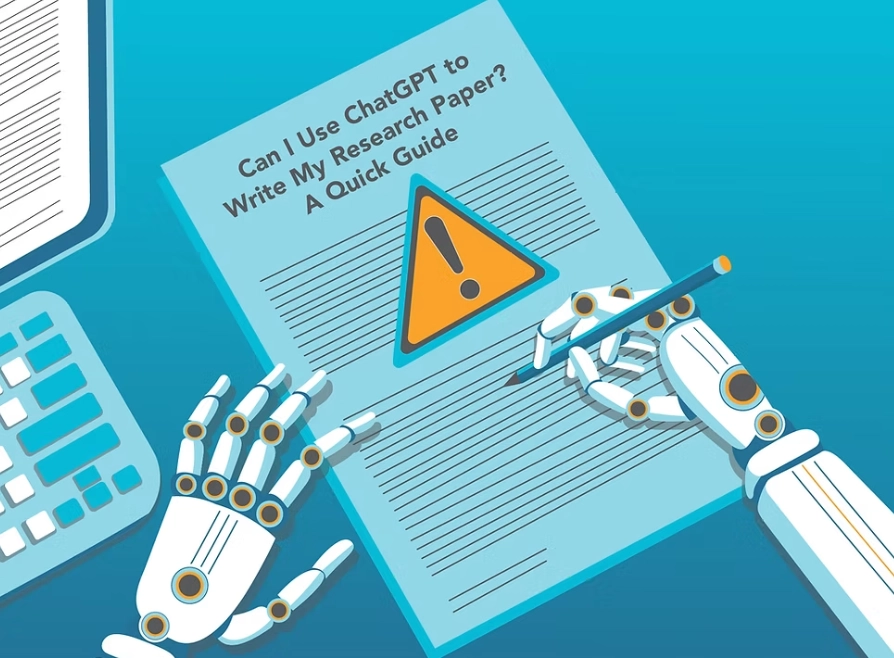
Avoiding AI Detection and Protecting Your Originality
This is a huge concern. Turnitin, GPTZero, and other detectors exist. The worst approach is to use an “AI humanizer” or “detector bypass” tool. It creates an arms race and often produces awkward, detectable text. The best defense is a good offense: original thought.
AI text often lacks depth, specific citations, and a consistent, personal narrative. Your paper has those. To ensure your work is unmistakably human:
- Use Primary Sources: AI is bad at analyzing raw data, interview transcripts, or archival material you’ve worked with directly.
- Include Personal Narrative: In your introduction or discussion, explain why you chose this topic, the challenges you faced in the research. AI can’t replicate your genuine experience.
- Engage Deeply with Citations: Don’t just name-drop authors. Critically engage with them. “While Smith argues X, my data suggests Y, which aligns more with Jones’s earlier point about Z…” This interconnected analysis is a human signature.
If you’re nervous, run a draft through a free detector yourself. If it flags parts, revisit those sections. Are they vague? Generic? Rewrite them with more concrete detail from your research.
Your Burning Questions, Answered
Reader Comments