Let's cut to the chase. If you're asking about the three types of accreditation, you're likely trying to figure out if a school or program is legitimate. Maybe you're a student comparing colleges, a professional looking at graduate programs, or an employer verifying a candidate's degree. The confusion is real. You hear terms like "regionally accredited," "nationally accredited," and "programmatically accredited" thrown around, and it's hard to know what actually matters.
The three primary types are institutional accreditation (which splits into regional and national) and programmatic accreditation. Getting this wrong can cost you tens of thousands of dollars, delay your career, or leave you with a credential that employers don't respect. I've seen it happen. A student transfers from a nationally accredited for-profit college to a state university, only to find out none of their credits transfer. That's a financial and emotional gut punch we can avoid.
Quick Navigation: What You'll Learn
What is Institutional Accreditation?
Think of institutional accreditation as a health check for the entire college or university. An independent, non-governmental agency evaluates the whole institution—its finances, faculty qualifications, student services, facilities, and academic mission. It's a yes-or-no stamp on the school's overall legitimacy.
This is the most fundamental layer. No reputable institution operates without it. But here's where it gets tricky, and where most people make their first mistake: institutional accreditation comes in two distinct flavors that are NOT created equal.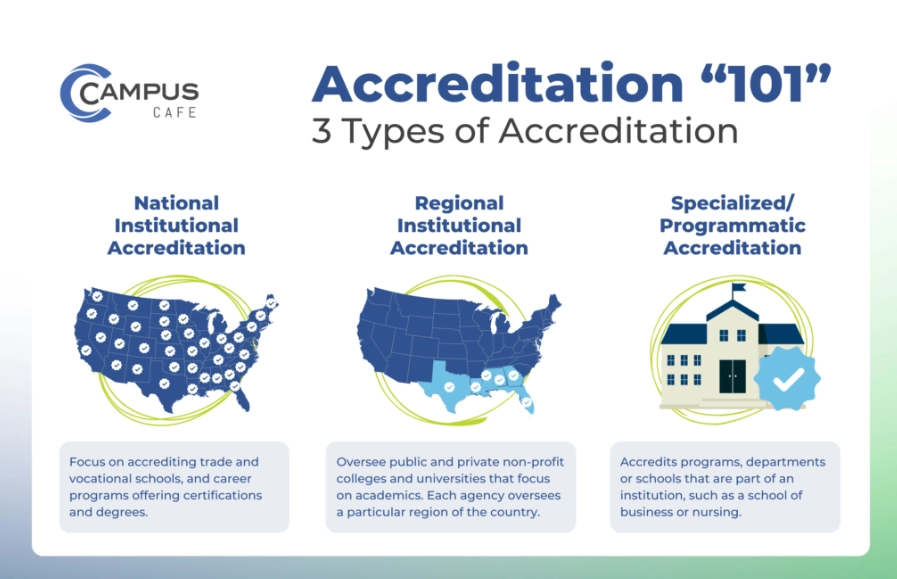
Regional vs. National Accreditation: The Big Divide
This is the single most important distinction you need to understand. It dictates credit transfer, degree recognition, and future opportunities.
| Aspect | Regional Accreditation | National Accreditation |
|---|---|---|
| Primary Focus | Traditional, academically-oriented colleges and universities (public, private non-profit). | Often career-focused, vocational, technical, or faith-based institutions (many are for-profit). |
| Scope & Prestige | Considered the "gold standard" in U.S. higher education. More rigorous and comprehensive review. | Often viewed as less prestigious. Standards can be more flexible regarding faculty and curriculum. |
| Credit Transfer | Credits and degrees are widely accepted by other regionally accredited schools. | Credits rarely transfer to regionally accredited institutions. It's often a one-way street. |
| Governing Bodies | Six regional agencies (e.g., MSCHE, SACSCOC, WSCUC). Recognized by CHEA and the U.S. Department of Education. | Agencies like ACCSC, ACICS, or ABHES. Also recognized by CHEA and USDE. |
Here's my blunt take: if your goal is a broad bachelor's degree, planning for graduate school, or keeping transfer options open, regional accreditation is almost always the safer, more versatile choice. National accreditation serves a purpose for specific trade skills, but the limitations are severe. I once advised a nurse who had an associate degree from a nationally accredited college; when she tried to enroll in a BSN program at a state university, she had to start over from scratch. The "savings" from the cheaper national school vanished instantly.
Key Takeaway: Always verify the type of institutional accreditation. A school saying simply "we are accredited" is a major red flag. Dig deeper. Is it regional or national? The name of the accrediting agency tells you everything.
What is Programmatic Accreditation?
Now, let's talk about the third type: programmatic (or specialized) accreditation. This one operates on a different level. While institutional accreditation looks at the whole school, programmatic accreditation zooms in on a specific department, school, or program within a larger institution.
This type of accreditation is about professional standards and industry relevance. It answers the question: "Does this specific program prepare graduates to competently enter this specific profession?"
You'll find programmatic accreditation in fields where there are clear professional standards, licensing requirements, or public safety concerns.
Engineering: The Accreditation Board for Engineering and Technology (ABET) accredits engineering and computing programs. Many state licensure boards require a degree from an ABET-accredited program.
Business: The Association to Advance Collegiate Schools of Business (AACSB) accreditation is a huge differentiator for business schools. It signals rigorous curriculum and faculty research.
Healthcare: This is critical. Nursing programs are accredited by the Commission on Collegiate Nursing Education (CCNE) or the Accreditation Commission for Education in Nursing (ACEN). For physical therapy, it's the Commission on Accreditation in Physical Therapy Education (CAPTE). Graduating from an accredited program is often a prerequisite to sit for your licensing exams.
Here's the expert nuance many miss: Programmatic accreditation does NOT replace institutional accreditation. A legitimate program will have both. The business school within a university should have regional accreditation for the university and AACSB accreditation for the business programs. If a law school (programmatically accredited by the ABA) is part of a university, that university still needs its own regional accreditation.
How to Check a School's Accreditation Status (Step-by-Step)
Knowing the types is theory. Applying it is power. Here's exactly what to do. Don't just trust the school's website or a recruiter's pitch.
Step 1: Go Directly to the Source. Never rely solely on a badge or claim on the institution's homepage. Go to the database of accreditors recognized by the U.S. Department of Education (DAPIP database) or the Council for Higher Education Accreditation (CHEA directory). These are the official, unbiased sources.
Step 2: Identify the Accrediting Agency. On the school's website, look for an "Accreditation" page, usually in the "About Us" section. It should name the specific agency (e.g., "Accredited by the Higher Learning Commission"). Write it down.
Step 3: Cross-Reference. Take that agency name and plug it into the CHEA or USDE database. Verify that the agency is indeed recognized and that the school is listed as an active member in good standing. Check the date of the last review and the next scheduled one.
Step 4: For Programs, Do a Separate Search. If you're looking at a specialized field, visit the website of the relevant programmatic accreditor (like ABET, AACSB, CCNE). They maintain their own directories of accredited programs.
This process takes ten minutes. Skipping it is the biggest mistake prospective students make.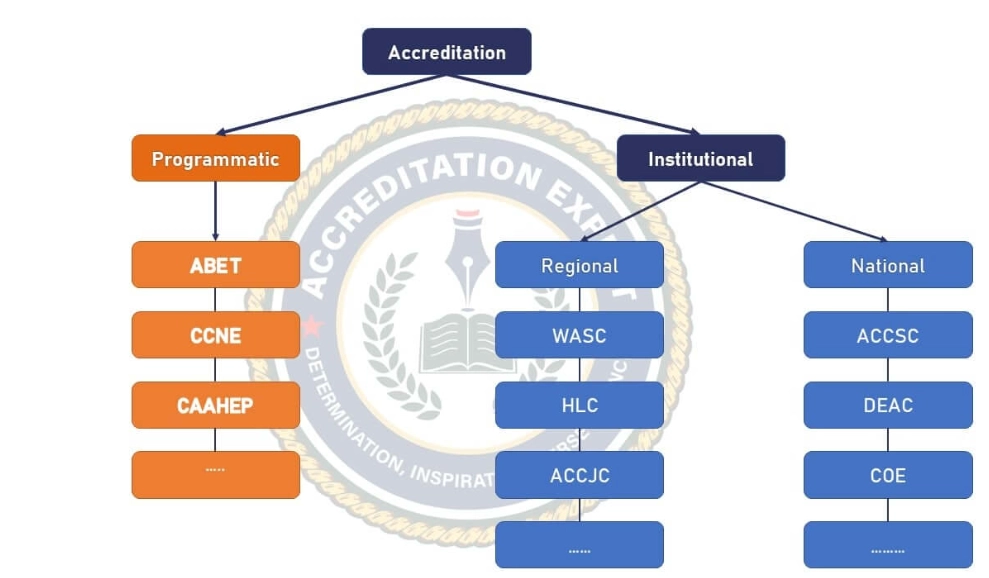
Your Accreditation Questions Answered
 I'm looking at online degrees. Does accreditation work the same way?
Reader Comments