Quick Navigation
- Why Even Consider the Transfer Route? (Beyond Just Saving Money)
- The Golden Rule: Plan Your Transfer From Day One
- The Nitty-Gritty: Building a Transfer-Ready Transcript
- The Application: It's Not Just a Form
- The Big Transition: What Happens After You Get In?
- Answers to the Questions You're Probably Searching For
- Final Reality Check
Let's be honest. The whole "community college to university" path gets talked about a lot, but the actual roadmap can feel pretty fuzzy. Is it really a smooth highway to a degree, or just a path full of confusing detours and credit transfer nightmares? I've seen friends sail through it and others hit every possible snag. The difference usually came down to one thing: information. Knowing the right steps, the right questions to ask, and the common pitfalls to avoid.
That's what this is for. This isn't a fluffy, inspirational piece. It's a practical, step-by-step manual for navigating the community college transfer process. We're going to talk about the real stuff—how to pick classes that actually transfer, how to deal with advisors (the good and the not-so-good), and what nobody tells you about life after you finally get to that four-year school.
Why Even Consider the Transfer Route? (Beyond Just Saving Money)
Everyone knows the cost part. It's the big, flashing neon sign. Tuition at a community college is often a fraction of the cost at a public four-year university, let alone a private one. You can knock out your general education requirements—the English, math, and history classes everyone needs—for thousands less. The American Association of Community Colleges (AACC) has tons of data on these cost savings, and it's undeniable.
But it's more than money.
For many students, a community college offers a softer landing. Class sizes are smaller. Professors are often focused on teaching rather than research. If you're returning to school after years away, or if your high school grades weren't stellar, it's a chance to rebuild your academic confidence without the intense pressure of a big university. You get a "do-over" on your GPA. I knew a guy who partied his way through high school, did miserably, then found his focus at our local community college. He built a 3.8 GPA there, transferred to a great engineering program, and is now doing incredibly well. That story is more common than you think.
There's also the flexibility. A lot of community colleges offer more night, weekend, and online classes. That's a lifesaver if you're working even part-time, or have family responsibilities. You can ease into the rhythm of college life.
Still, the ultimate goal for most is that bachelor's degree. The community college transfer is the strategic link between an affordable start and a prestigious finish.
The Golden Rule: Plan Your Transfer From Day One
This is the single most important piece of advice, and the one most people ignore until it's too late. Don't just sign up for classes that sound interesting. Every class you take should be a deliberate step on your transfer pathway.
How? You need a target. You don't necessarily need to pick the exact university on day one, but you should at least have a *type* in mind—a state public university, a specific private college, etc. This is crucial because transfer requirements are not universal.
Your Two Best Friends: The Articulation Agreement and the Transfer Advisor
An articulation agreement is a formal contract between your community college and a specific four-year university. It literally spells out which of your community college courses will transfer and what requirements they will fulfill at the university. Some are broad (general education block transfers), and some are detailed for specific majors (like a guaranteed admission pathway for engineering students).
Your first stop should be your community college's transfer office website. Search for "articulation agreements" or "transfer partners." If your dream school is on that list, you've just found your blueprint. Follow it religiously.
Now, about advisors. This is where experiences vary wildly. Some transfer advisors are phenomenal, up-to-date, and proactive. Others are overworked and might give generic advice. My advice? Treat meetings with your advisor like a job interview. Go in prepared.
- Before the meeting: Have a list of 2-3 target universities and your intended major.
- Ask specific questions: Don't just ask "what should I take?" Ask, "For a transfer to [University X]'s Business program, does BUS 201 here articulate as their equivalent of MGMT 101 per the agreement?"
- Get it in writing: If an advisor makes a promise about a course transferring, ask if you can get an email confirmation or see the official documentation. This protects you down the line.
If your target school doesn't have a formal agreement, don't panic. It just means you need to do more legwork. You'll become best friends with the course catalog of your target university and your own community college catalog. You'll need to compare course descriptions, learning outcomes, and sometimes even syllabi to make a case for course equivalency later.
The Nitty-Gritty: Building a Transfer-Ready Transcript
So what are universities actually looking for when they review your community college transfer application? It boils down to three things:
- A Strong GPA: This is non-negotiable. For competitive majors (Engineering, Nursing, Business) at popular universities, the expected GPA can be 3.5 or higher. For general admission, 3.0 is often a safe baseline. Your community college GPA is the primary proof you can handle university-level work.
- The Right Courses: Completing an Associate Degree for Transfer (ADT) or similar (like an Associate of Arts or Science) is often the best move. Many states have laws or policies that guarantee admission to a state university (though not necessarily to a specific campus or major) if you complete one of these degrees with a certain GPA. Even without a guarantee, it shows you've completed a coherent block of lower-division work.
- Major Preparation: Have you taken the introductory courses for your intended major? If you want to transfer as a Biology major, you better have Bio, Chem, and maybe Calculus on your transcript. Universities want to see you're prepared to jump into upper-division (junior and senior level) courses in your major right away.

Here’s a rough timeline that has worked for many successful transfer students:
| Semester | Key Actions & Focus | Pro-Tip |
|---|---|---|
| Semester 1 | Focus on GPA. Knock out 1-2 general ed requirements. Meet with a transfer advisor. Research 3-5 potential universities. | Use a tool like the U.S. Department of Education's College Navigator to compare transfer rates and policies. |
| Semester 2 | Declare your intent to transfer (at your CC). Start major prep courses. Attend transfer fairs (virtual or in-person). | Connect with the transfer admissions office of your top-choice school. Ask if they have a dedicated transfer counselor. |
| Semester 3 | Finalize target school list. Begin drafting application essays. Request letters of recommendation from professors who know you well. | Letters from CC professors who can vouch for your work in a classroom are gold. |
| Semester 4 | Submit applications (deadlines are often earlier than for freshmen!). Complete your Associate's degree. Apply for financial aid (FAFSA) for your transfer year. | The FAFSA uses "prior-prior year" income. You're applying for aid for your *university* years while you're still at your CC. |
The Application: It's Not Just a Form
The transfer application is your story. You're not a high school senior anymore. The admissions officers want to know: Why did you choose the community college path? What have you accomplished there? Why is our university the logical next step for your goals?
The Personal Statement/Essay is critical. This is where you explain any past academic stumbles (like that rough first year of college right out of high school, if that's your story). It's where you articulate your purpose. Don't just say "to get a better job." Be specific. "My coursework in introductory programming at [Community College] ignited a passion for solving logistical problems with code, which is why I am seeking the robust Data Structures and Algorithms sequence offered in your Computer Science program." See the difference?
Letters of Recommendation: A glowing letter from a community college professor who saw you overcome a challenge, lead a group project, or show remarkable improvement is worth its weight in gold. Build those relationships. Go to office hours.
The Big Transition: What Happens After You Get In?
Congratulations! You did it. But the work isn't over. The transition from a community college to a large university can be a cultural shock.
- Socially: Friend groups are often already formed by junior year. You have to be proactive. Join clubs related to your major immediately. Attend department events. This is how you build your network.
- Academically: The pace is often faster. The expectations for independent work are higher. Don't be afraid to use the university's tutoring center, writing center, or professor's office hours from the very first week. It's not a sign of weakness; it's a sign of smart strategy.
- Financially: Your financial aid package will likely change. Scholarships specific to transfer students exist—look for them! Also, budget for the increased cost of living if you're moving.
I won't sugarcoat it—the first semester after transferring can be tough. You're the "new kid" in advanced classes. But remember, you earned your spot there through disciplined work. You belong.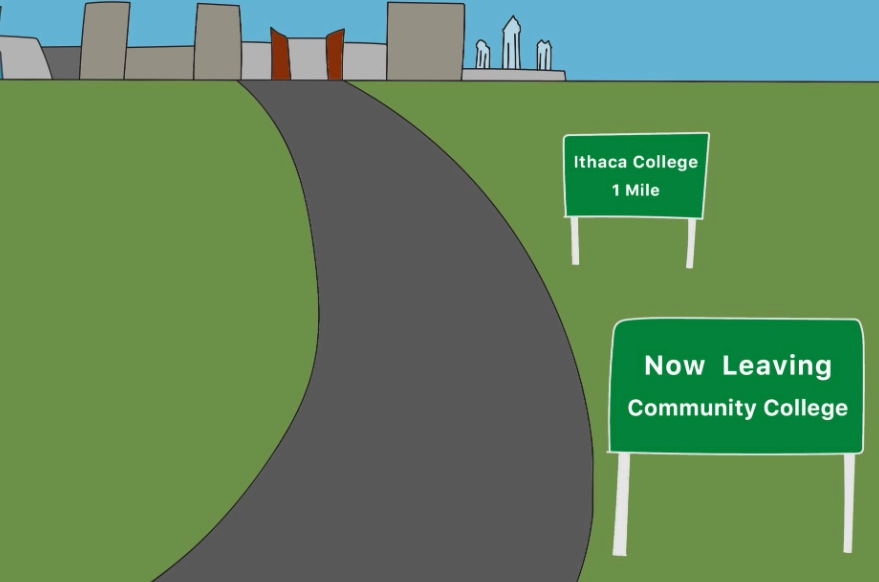
Answers to the Questions You're Probably Searching For
Let's tackle some of those specific, nagging questions that keep students up at night.
Will my community college credits expire?
Generally, no, college credits don't have an official "expiration date." However, for subjects that change rapidly—like Computer Science or certain areas of Biology—a university might question the relevance of a course taken 10 years ago. They may still accept it for general elective credit, but not for fulfilling a major requirement. It's always best to transfer credits as soon as possible after earning them.
Do universities look down on community college transfers?
This is a common fear, and it's mostly a myth. University admissions offices actively recruit successful transfer students. You bring diversity of experience, proven collegiate-level aptitude, and often, a clearer sense of purpose. Data from the National Student Clearinghouse Research Center shows that students who transfer from two-year to four-year colleges often graduate at rates comparable to, or in some cases, higher than, students who started as freshmen. They see your journey as a strength, not a weakness.
What if my credits don't all transfer?
First, appeal. If you have a detailed syllabus showing your course covered 80% of the same material as the university's course, you can often appeal the initial evaluation. Provide that documentation to the university's registrar or academic department. Sometimes you win, sometimes you don't. Credits that don't fulfill a specific requirement may still come over as general elective credits, helping you reach the total credit count needed to graduate.
Should I get my Associate's degree before transferring?
In almost all cases, yes. It gives you a formal credential to fall back on. More importantly, it often triggers the fullest benefits of articulation agreements, like guaranteed admission or the complete fulfillment of general education requirements. It's a clear finishing point that universities understand and respect.
Final Reality Check
The path from community college to a university degree is one of the most pragmatic and powerful moves in higher education. It demands front-loaded effort—more planning, more questions, more double-checking than the typical freshman path. But the payoff is immense: significant debt reduction, a stronger academic record, and a degree from the university of your choice.
Start your community college transfer plan now. Dig into those articulation agreements. Build relationships with professors. Write a compelling story about your journey. It's not the easier path, but for countless students, it's the smarter, more strategic one. And when you finally walk across that stage to get your bachelor's degree, the fact that you started at a community college won't be a footnote—it'll be the foundation of your success story.
Reader Comments