Let's be real. The college application process feels like navigating a maze in the dark sometimes. You're trying to put your best foot forward, tell your story, and hope some admissions officer sees the potential in you. And right in the middle of this stressful journey, you hit a major fork in the road: is it better to apply for an early decision or a regular decision?
Your Quick Guide
- Cutting Through the Jargon: What Do These Terms Actually Mean?
- The Core Differences: A Side-by-Side Look
- The Big Question: Does Early Decision Actually Increase Your Chances?
- The Pros and Cons: No Rose-Colored Glasses Here
- Who Should Seriously Consider Early Decision? (A Checklist)
- Navigating the Financial Aid Minefield
- Crafting Your Personal Application Strategy
- Answering Your Burning Questions (The FAQ)
- Final Thoughts: It's About Fit, Not Just Admission
I've talked to hundreds of students over the years, and this question comes up every single time. There's no one-size-fits-all answer, and anyone who tells you there is probably oversimplifying things. The truth is buried in the details of your own situation – your academic record, your financial needs, and honestly, how sure you are about that dream school.
Some people swear by early decision, saying it was their ticket in. Others regret it, feeling they rushed into a binding commitment without exploring all their options. So how do you know which path is yours?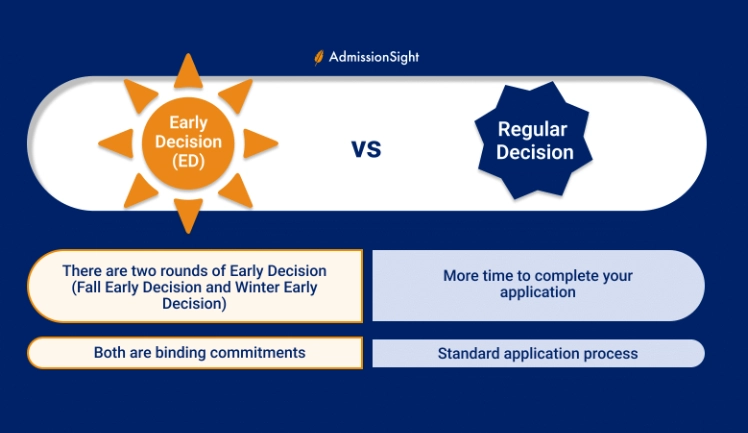
Cutting Through the Jargon: What Do These Terms Actually Mean?
Before we dive into the heavy stuff, let's make sure we're all on the same page. College admissions has its own language, and it's easy to get the terms mixed up.
Early Decision (ED): The Binding Promise
Early Decision is a binding agreement. That's the key word – binding. When you apply ED to a college, you're signing a contract (often with your counselor's signature too) stating that if this college admits you, you will enroll and withdraw all other applications. No shopping around for better financial aid packages. No waiting to see if an Ivy League comes calling. It's a committed relationship before the first date, in a way.
Deadlines are usually in early November (November 1st or 15th are common), and you get your decision by mid-December. The options are typically: Admit, Deny, or Defer (which means they push your application into the regular decision pool for another look).
There's also something called ED II, which has a later deadline (often January 1st or 15th) but carries the same binding rule. It's for students who missed ED I or who had a strong fall semester they want to include.
Early Action (EA): The Non-Binding Preview
This one often gets confused with ED, but it's crucially different. Early Action is non-binding. You apply early (similar deadlines to ED), get a decision early, but you are under zero obligation to attend. It's a great way to get a likely yes or no from a favorite school without your hands being tied. You can apply EA to multiple schools, unlike the single-school restriction of ED. Some colleges have Restrictive or Single-Choice Early Action, which means you can't apply EA to other private schools, but public universities are usually fair game. Always check the specific policy.
Regular Decision (RD): The Traditional Route
This is the standard timeline most people think of. Deadlines range from January 1st to January 15th for many schools, with some stretching into February. You get your decisions in March or April, and you have until the universal reply date of May 1st to make your choice and submit a deposit. It gives you the most time to prepare your application, includes your full first-semester senior grades, and allows you to compare offers from every school that admits you.
So, when you're asking is it better to apply for an early decision or a regular decision, you're really asking: "Do I want to play the high-stakes, committed card now, or keep my options open and play the field?"
The Core Differences: A Side-by-Side Look
Talking about it is one thing. Seeing it laid out clearly is another. This table breaks down the head-to-head comparison between Early Decision and Regular Decision. Keep it handy.
| Factor | Early Decision (ED) | Regular Decision (RD) |
|---|---|---|
| Commitment Level | Binding. You must attend if admitted. | Non-binding. You can choose among offers. |
| Application Deadline | Early Nov (Nov 1/15). ED II in Jan. | Typically Jan 1 - Feb 1. |
| Decision Notification | Mid-December. | Late March to Early April. |
| Your Reply Deadline | Implicit upon acceptance. | May 1 (National Candidate's Reply Date). |
| Strategy Leverage | Shows strong, demonstrated interest. Can boost chances at some colleges. | Allows for full senior year grades and achievements to be considered. |
| Financial Aid Impact | You must accept the aid package offered. Less room for comparison/negotiation. | Can compare aid packages from multiple schools. More negotiation leverage. |
| Stress Timeline | High stress earlier, potentially done by December. | Prolonged stress, but culminates in multiple options in spring. |
| Best For... | The student with a clear, unwavering first choice, regardless of financial variables. | The student who wants options, needs to compare financial aid, or is still deciding. |
See the trade-offs? ED gives you a potential advantage and an early finish line, but at the cost of all your leverage and freedom. RD is the marathon – longer, more uncertain, but you get to finish and survey the entire landscape.
The Big Question: Does Early Decision Actually Increase Your Chances?
This is the million-dollar question, and the answer is frustratingly nuanced: it depends on the college.
Look, colleges are institutions, but they're also businesses. They care about their yield rate – the percentage of admitted students who actually enroll. A high yield makes a college look more desirable and selective. Since an ED admit is a guaranteed enrollment, filling a portion of the class through ED is a surefire way to lock in a high yield. From the college's perspective, it's efficient.
Many selective private colleges admit a significant chunk of their class through ED. You can often find this data in their Common Data Set (look for Section C-7). For example, a college might have an overall acceptance rate of 10%, but an ED acceptance rate of 15-20%. That's a statistical advantage. But – and this is a huge but – the ED pool is also typically filled with exceptionally strong candidates: legacies, recruited athletes, and students who have been targeting that school for years. The competition is fierce, just in a smaller pool.
So, does applying ED give you a *bump*?
Often, yes, for the college's strategic reasons. But it doesn't turn a weak application into a strong one. You still need to be within the academic range of the school's admitted students. It might be the deciding factor between two otherwise equal candidates.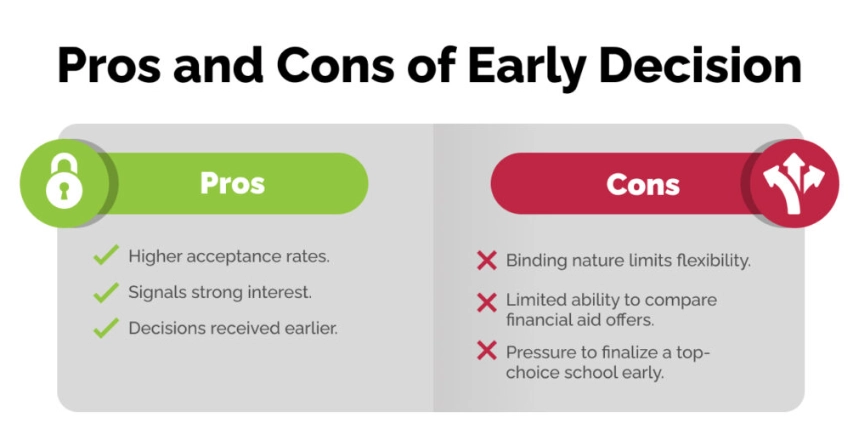
The Pros and Cons: No Rose-Colored Glasses Here
Let's get brutally honest about the benefits and drawbacks of each path. I'm not here to sell you on one; I'm here to help you see the potential outcomes, good and bad.
The Allure and the Pitfalls of Early Decision
- Potential Admissions Advantage: As discussed, showing that level of commitment can work in your favor at many schools.
- Early Resolution: Getting an acceptance in December is an incredible feeling. Your senior year becomes a victory lap instead of a waiting game. The stress evaporates.
- Demonstrates Serious Interest: There's no more powerful way to say "This is my top choice" than signing a binding agreement.
- The Binding Contract: This is the big one. You are legally and ethically bound to attend. Backing out is possible only in extreme circumstances (like a catastrophic financial change your family can prove), and it burns bridges.
- Financial Aid Limitation: This is the deal-breaker for many families. You apply for aid, but you must accept whatever package they offer. You cannot compare it to other offers or use a better offer to negotiate. If the aid is insufficient, you're in a very tough spot. You must run the Net Price Calculator on the college's website with your parents beforehand.
- Less Time to Prepare: Your application is due in October/November, so you can't include first-semester senior grades or late-breaking achievements.
- Potential for Regret: What if you change your mind in January after visiting other schools? Too late. The grass might look greener, but you can't go water it.
The Flexibility and The Anxiety of Regular Decision
- Complete Freedom of Choice: You get to make the decision in April with all cards on the table. This is empowering.
- Financial Aid Comparison: You can compare packages from multiple schools. This can lead to better outcomes and even negotiation. "School B offered me a better grant, can you match it?" is a powerful question you can only ask as an RD admit.
- Stronger Application: You have more time to polish essays, retake standardized tests (if applicable), and include your entire first-semester senior year performance, which can show an upward trend.
- More Exploration Time: You can visit campuses, attend admitted student days, and really be sure of your fit in the spring.
- Longer Wait, More Anxiety: The application season drags on for months. The "what ifs" can be mentally exhausting.
- Potentially Lower Chance: At some schools, you might be competing for fewer spots in the RD round, making it statistically more challenging.
- May Miss Early Community: Some schools start connecting ED admits earlier, so RD students might feel like they're joining a party that's already started.
See the pattern? ED trades freedom for potential advantage and peace of mind. RD trades a longer period of uncertainty for ultimate control and choice. Which currency is more valuable to you?
Who Should Seriously Consider Early Decision? (A Checklist)
Let's get personal. ED isn't for everyone. If you check most of these boxes, it might be a strong path for you. If you don't, RD is probably your wiser choice.
- You Have a Clear, Unshakeable First Choice: Not just a "dream school" based on rankings, but a deep, researched conviction that this is the best place for you academically and socially. You've visited, you've read the course catalog for fun, you can name specific professors or programs.
- Your Academic Profile is a Strong Match: Your GPA, test scores (if submitted), and course rigor are solidly within or above the school's middle 50% range for admitted students. ED is for reinforcing a strong application, not salvaging a weak one.
- Financial Aid is Not a Deciding Factor: Your family has run the Net Price Calculator (the College Board's tool is a good start) and is comfortable with the estimated cost, or you are confident the school meets 100% of demonstrated need. If money is a major concern, RD is safer.
- You Are Ready to Commit in November: You won't second-guess yourself in March when other acceptances roll in. You're sure.
I remember a student a few years back who was dead-set on a particular liberal arts college. She loved its interdisciplinary approach, had already connected with a professor there, and her family finances were settled. ED was a no-brainer for her. She got in, and it was the right fit. Another student was torn between two great engineering schools. He went RD, got into both, and was able to compare research opportunities and visit both campuses in April before choosing. Both were the right paths for those individuals.
Navigating the Financial Aid Minefield
We have to talk about money separately because it's the single biggest reason ED goes wrong. The myth is that applying ED hurts your financial aid offer. That's not exactly true. Colleges claim to use the same formula to calculate need for ED and RD applicants. The problem is the lack of leverage.
If an RD school gives you a poor aid package, you can walk away and go to a school that gave you a better one. The first school might even lose you. If an ED school gives you a poor package, you're still obligated to go. They have no incentive to be generous because you can't leave. While they will work with you in cases of true miscalculation, you are not in a position of strength.
What you MUST do before applying ED:
- Use the college's official Net Price Calculator (NPC). This is non-negotiable. Enter your family's financial information as accurately as possible. Treat this result as a serious estimate of your bill.
- Have a frank conversation with your parents/guardians. Can they comfortably afford the NPC estimate for four years? If the answer is "no" or "we're not sure," ED is a massive risk.
- Understand the difference between need-based aid (grants, scholarships based on your FAFSA/CSS Profile) and merit aid (scholarships for talent/academics). Some schools don't offer merit aid to ED applicants because they don't need to attract you.
Crafting Your Personal Application Strategy
Okay, so you've weighed everything. How do you actually build a smart application list that uses ED and RD strategically? It's like a chess game.
The Balanced Approach (The Most Common)
Apply ED I to your absolute top choice (if you're 100% sure and finances align). Apply EA to a few other favorites (non-binding, gives you early options). Apply RD to a balanced list of target, match, and safety schools. This gives you an early shot at your dream but ensures you have excellent options no matter what.
The ED II Gambit
Maybe your top choice in November was just out of reach academically. You have a strong fall semester that boosts your GPA. An ED II application to a slightly less selective (but still fantastic) dream school in January can show renewed commitment and include those improved grades.
The All-In RD Strategy
You apply only Regular Decision to all schools. This is perfect for the undecided student, the one who needs to compare financial aid, or the student who wants every last grade and accomplishment counted. There is zero shame in this. It's a prudent, conservative, and completely valid approach.
The key is to build a list where you would be genuinely happy to attend any of the schools you're applying to, especially your likely safeties. Your safety school should be one you like, not just one you think will accept you.
Answering Your Burning Questions (The FAQ)
If I get deferred from ED, what happens?
Your application gets re-reviewed in the RD pool. This is not a rejection! Send a letter of continued interest (LOCI) to the admissions office. Update them on any new grades, awards, or accomplishments. Reiterate that the school is still your top choice (if it is). Sometimes, a strong LOCI can make a real difference.
Can I back out of an ED agreement for financial reasons?
Technically, yes, if the aid package is insufficient to make attendance possible. The process is difficult. You must provide documented proof to the college's financial aid office that their package, combined with your family's resources, is inadequate. They may review it, but it's not a given. It can also jeopardize your standing at other colleges if word gets out you broke an ED agreement. This is why the pre-application Net Price Calculator step is so critical.
Do athletes have different rules?
Yes. The NCAA has specific recruiting calendars. A recruited athlete being pressured to apply ED should have a clear, written offer from the coach detailing the athletic scholarship/recruitment terms before committing. Never apply ED for athletics on a verbal promise alone. The official NCAA website is the resource for these rules.
How do I know if a school values ED?
Research! Look at the Common Data Set (search "[College Name] Common Data Set"). Section C-7 shows the number of applicants, admits, and enrollees for Early Decision and Early Action. If a school enrolls 40-50% of its class from ED, they heavily rely on it. If the number is tiny, the "boost" is likely minimal.
What's the single biggest mistake students make?
Applying ED for the wrong reason: because they think it's "the thing ambitious students do" or because they're desperate to get into a selective school, any selective school, rather than being genuinely committed to that specific institution. It leads to the worst outcome: acceptance followed by regret.
Final Thoughts: It's About Fit, Not Just Admission
At the end of the day, the question "is it better to apply for an early decision or a regular decision?" is secondary to a bigger one: "Which path leads me to the college where I will thrive?"
The college admissions process feels like the end goal, but it's just the doorway. What matters is the four-year experience on the other side. An ED acceptance to a school that's a poor fit for your personality or financial reality is a pyrrhic victory. An RD process that leads you to a school you chose confidently among great options is a true success.
My advice? Block out the noise from peers, rankings, and prestige. Have those hard conversations about money with your family. Do the deep research on what you really want from a college. Be brutally honest with yourself about your level of certainty.
If, after all that, you have a clear frontrunner and the finances work, Early Decision can be a beautiful, strategic way to express your commitment and potentially gain an edge. If you have any doubt, if you want to keep options open, if financial aid comparisons are essential – then Regular Decision is the wise, powerful choice. There is no "better" in a vacuum. There's only what's better for you.
Good luck. Make your choice with your eyes wide open, and own it.
Reader Comments